
Water under pressure: why efficient filtration is becoming increasingly important

Groundwater: an invisible treasure under pressure
When precipitation reaches the ground and infiltrates the soil, it undergoes a natural purification process. As the water passes through different layers of soil, it is naturally filtered before reaching the groundwater. Groundwater is an important source of drinking water and also contributes to the supply of springs, streams and rivers.
But this natural cycle is increasingly being disrupted.
Climate change is leading to longer periods of drought and increased evaporation. At the same time, precipitation is increasingly occurring in the form of heavy rainfall events. With the growing amount of impermeable surfaces, less water can infiltrate into the soil. Instead of slowly infiltrating the ground and contributing to groundwater recharge, a significant proportion of the water runs off at the surface.
More rainfall therefore does not automatically mean more water is available.
The essential question is rather: how can we use the available water as efficiently as possible while preserving its quality?

Saving water starts with using it responsibly
Using water responsibly is an important first step. Taking shorter showers, using water-efficient equipment, operating washing machines and dishwashers efficiently, or collecting rainwater for certain applications: many measures can easily be integrated into everyday life.
But saving water does not only mean using less water. It is also important to make optimal use of the available water and to take its quality into account.
This is precisely where water filtration plays an important role.
With Cintropur, you can collect rainwater that no longer infiltrates the soil as effectively and reuse it for various everyday applications.
Filtration: using water efficiently and protecting installations
Once the rainwater has been collected, it needs to be filtered.
Depending on where the water has been collected and stored, it may contain various suspended substances and mechanical impurities. These may include sand, rust particles, leaf residues, bird feathers, sludge or other solid particles.
Suitable mechanical filtration effectively removes these particles from the water and therefore contributes to better control of water quality.
Cintropur relies on an efficient principle of mechanical filtration.
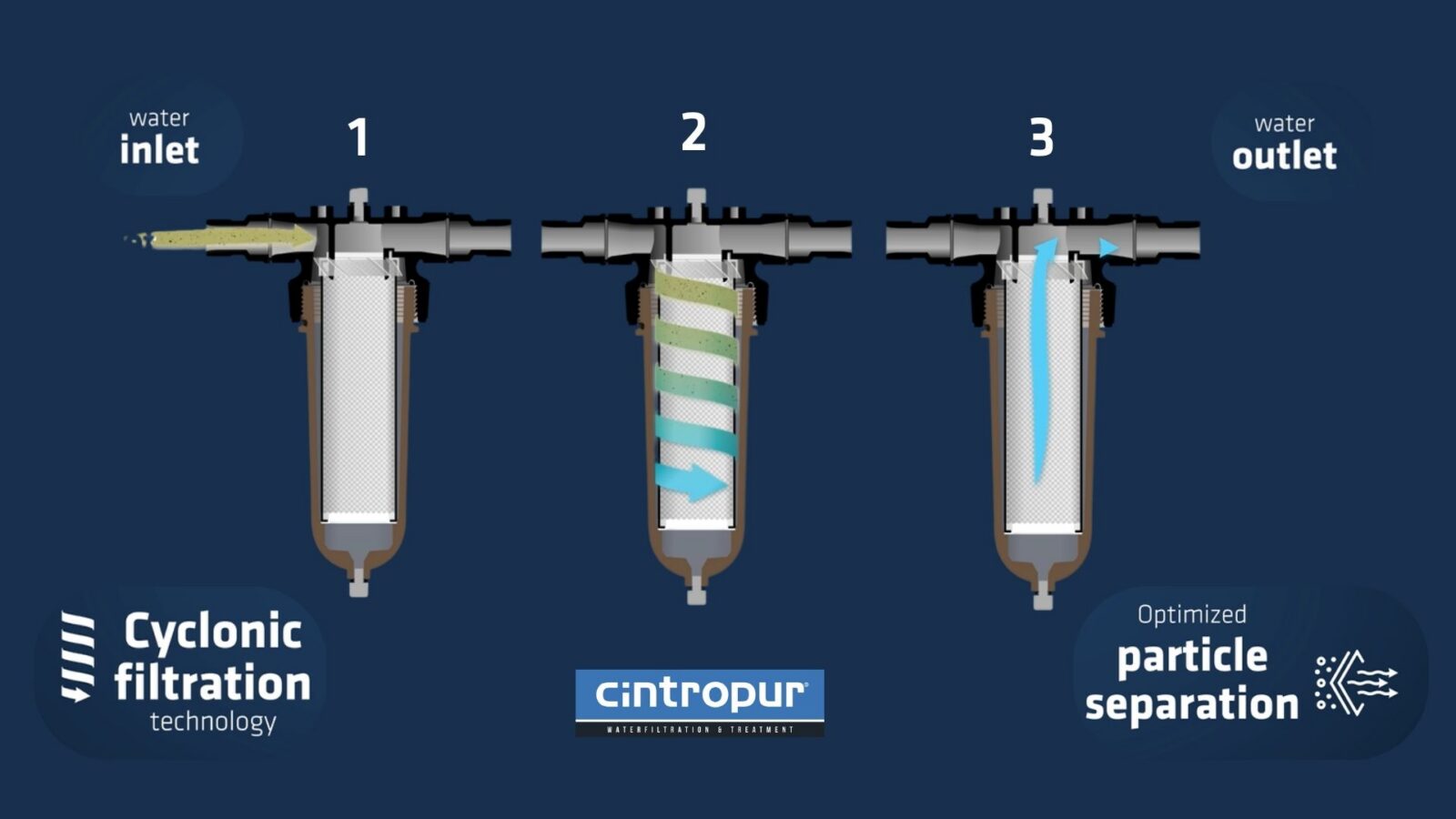
Cintropur water filters use centrifugal separation: when water enters the filter, it is set into rotation. Larger and heavier particles are separated by centrifugal force and collected in the lower part of the filter housing. The filter cartridge then provides fine filtration.
The result is a combination of pre-separation and fine filtration, which reduces the load on the filter cartridge and ensures efficient filtration.
Cintropur: filtration designed for efficiency
Efficient water filtration can offer much more than simply removing particles.
Water free from mechanical impurities can help protect downstream equipment and components, such as taps and fittings, household appliances, irrigation systems and technical installations, from unwanted particles.
This aspect is particularly important wherever water is used regularly. Deposits and particles can place additional strain on components, increase maintenance requirements and potentially reduce the service life of equipment.
Cintropur therefore combines high-performance mechanical filtration with a filtration system designed for efficiency, making a tangible contribution to more responsible water use.
Source: Schrot & Korn